Sign up to our irregular e-newsletter here

Sunday, 5 July 2020

Internet Explorers


If waking up some mornings with the lockdown blues, here are some alternative on-line wildlife events, some local, some not so local ... 


Agile Rabbit, University of Exeter-based, talks on various topics from top name speakers, including on wildlife research and conservation subjects. Past talks back to 2018 viewable on embedded YouTube podcasts on Agile Rabbit webpage

For live talks, join by Zoom https://www.agile-rabbit.com/


Art and Energy Moths to a flame – Devon-based, learn about moths each month this summer and take part in an art project which will be travelling to the re-scheduled next international climate change conference Cop26 in Glasgow 2021.

Monthly moth events 1 hour on Friday Eve – 1 hour on the following Saturday morning virtually visiting sites around Devon. For live talks, book via Eventbrite, join by Zoom


Field Studies Council Virtual Meetups – talks on wildlife projects and subjects.
Learn about oil beetles, ladybirds, barberry carpet moth, chequered skipper butterfly, dormice, hedgehogs, insect coloration, bees ….

On FSC YouTube VMU channel – new talks added weekly


Cumbria Wildlife Trust talk ‘Averting the Insect Apocalypse' and what we can do at home, by Professor Dave Goulson, leading bumblebee expert, author, one time marker of my undergraduate essays …


You can learn more about insect-friendly gardening from Dave's YouTube channel, and his books A Sting in the Tale, A Buzz in the Meadow, Bee Quest and the latest The Garden Jungle. You can also look at his research papers.


Monday, 19 February 2018

If on a winter's night a traveller ...

Out on a nocturnal expedition, and discovered I wasn’t the only one.

A shape on the path, its coloration blending in orangely with the surroundings under the sodium light, adumbrated by shadow. There as still as a statue, as if it had both just materialised that instant and also been there all along for centuries, was a large frog, squatting crouched in its sumo pose, jewel eye impassively taking in the scene, weighing up a next move.


Time and toad wait for no one ....

A few more steps and there was another, then another, and a mature palmate newt, then another newt, a toad, then more toads and frogs, at intervals along the church path. All 3 of our common species were on the march, on one short brief stretch of urban Exeter footpath. One could imagine the earth had belched them up from some netherworldly subterranean place, an amphibian version of a Stanley Spencer mass resurrection for spring.

The last few nights had been mild and wet, constantly damp, intermittent rain, then more rain, with nocturnal temperatures tipping above 5oC. This must have been the trigger to stir from hibernation, emerging from damp corners of gardens from under stones, paths, sheds, and the soil.

It’s easy to forget about the terrestrial part of the amphibian lifecycle, and that most of the amphibian year is spent away from the pond - apart from the breeding season. In these squally warmer wet nights, the moist atmosphere aids breathing through the skin and gives less risk of dehydration, plus means that ditches and ponds may be filling up. Collective emergence gives better odds that any one individual will survive the gathering attention of predators.
Toadzilla, on the march (on some screens this may be too dark to see)
It’s said that the older and larger individuals make the migration trek earlier, possibly trading off safety in return for the chance to claim first the best breeding opportunities. Certainly the participants in this evening’s ‘frogtide’ were mature animals, collisions leading to amplexus grabs and toads inflating in alarm, presaging the contests to come. Soon there will be spawn, soon spring will be on the way.

Sunday, 14 January 2018

A Hawfully Big Adventure

From October 2017 onwards we’ve been experiencing a massive ‘irruption’. Several thousands of usually rare Hawfinches arrived unexpectedly in the UK this winter, said to be due to a good breeding year, followed by failure of food crop sources in Germany and Romania, with journey possibly aided by storm Ophelia, and any return trip possibly postponed by storm Eleanor. Some have made it as far as central Exeter, loitering for a time around St Thomas churchyard and the pleasure grounds over the road, and then at Exwick Cemetery. 

Totally Hawsome: Exwick cemetery woodland burial area
This is a special bird and a special opportunity. The national breeding population hovers around 500-1000, with fidelity to certain locations, and stronghold in south east England1. These last few months have welcomed thousands to the UK, sometimes seen in flocks fifty or more strong, instead of the average grouping of 7-8. 

Size matters; this largest finch, with the biggest beak and head, the longest scientific name among our UK songbirds Coccothraustes coccothraustes, and in the largest numbers - surely something this distinctive should be easy to spot? 

Afraid not. Hawfinches are "notoriously self-effacing" and "the most challenging songbird to observe well"2. Generally a woodland specialist, secreted circumspectly high in the upper canopy, fawn plumage blending in with bare trunks, with a relatively quiet infrequent song, and flying off stealthily at the slightest hint of disturbance, the spotter’s traditional first - and last - view of a Hawfinch is a flash of white feathers on long dark tapering wings either side of a short tail, in a bounding flight…. as they disappear away out of sight over the treetops….

Chances of good sightings of these enigmatic visitors at Exwick cemetery then seemed low. But we could increase the odds maybe with some received knowledge and strategy: start with any woodland areas; scan the uppermost treetops; check especially cherry trees; look out for slight movements of silhouettes which turn out to be unusually large perching birds with short tails; be still, watchful, patient. There were not going to be many close-up photo opportunities. 

Exwick cemetery has lots of cherry trees as well as numerous grand old standard trees. A green burials woodland area, the treetops of which can be viewed from paths, seemed promising in theory. A flock of 5 Hawfinches was reported on Saturday afternoon, on cherry trees at the top of the site. 

In the first hour we tried a few different vantage points. Movements turned out to be long-tailed tits, chaffinches, a bullfinch, goldcrest, blackbirds and squirrels, once a sparrowhawk darting between the trunks. There was a keen northerly wind. Looking up at the canopy and thin glare of the low winter sun, some minutes were spent in careful intense observation of a clump of leaves.
 
There's a Hawfinch in this pic somewhere - can you spot it?

And then, the slightest shifting out from behind the top of a cherry trunk on to an upper bough, part of a bird shape which seemed to be playing a trick of perspective appearing larger by being closer. Except it was indeed large, deftly plucking a cherry with an enormous beak. Once glimpsed, and locked on to with the binoculars, it was unmistakable. 

The characteristic bill allows monopolisation of a specialised feeding niche, on tough-coated haws, sloes, cherries especially, and beech mast, amongst other seeds. It’s possible to tackle these when your face is equipped with a pair of bolt croppers. For the Hawfinch's scientific name Coccothraustes ‘kokko’ from Greek means ‘kernel’ and ‘thrauo’ ‘I break in pieces’.

This might be it .... or not

Nature's engineering design is much more sophisticated than bolt-croppers: 4 horny pads inside the upper and lower palates hold the seed or stone in place, while distributing bite force evenly across the massive cheek muscles – the reason for the heavy-set neck and head. The crunch of the bite force is estimated to be 1000 times the bird's own weight, exerting 50-60 g/sm (1950s experiments found that 27-43kg was needed to crack open cherry stones). It is said bird ringers' knuckles, when trying to ring Hawfinches, regularly also feel this force3

It was fascinating to observe the bill in action, not just the strength but also the nimbleness dealing with the cherry stones. Our vigilance was rewarded with sightings of 3-4 more birds. Satisfied with the morning's venture, we went in search of a warming cup of tea, and to see how the photos came out.... 


Postscript: as ever, I should leave it to the professionals. Here's a pic posted on the proper Devon Birds website - for more authoritative interweb information about Devon's birds and sightings, this is the place to visit.
from Devon Birds website - Hawfinch at Haldon by J. Deakins

References
Wikipedia and Birdtrack website 2017 
Peter Lack 1986 The Atlas of Wintering Birds in Britain and Ireland Poyser, London
3 from M Cocker and R Mabey 2005 Birds Britannica Chatto & Windus, London, and Jonathan Elphick 1997 / reprint 2001 The BBC Birdwatcher’s Handbook A Guide to the Birds of Britain and Ireland BBC Worldwide Ltd 
    – Jonathan is speaking to Topsham Birdwatching and Naturalist group on Friday 9 March 


Tuesday, 4 April 2017

Goodbye Dave

David Ireland 1974 - 2017

If you've come along to a Devon Wildlife Trust Exeter Local Group event in the last year, chances are you would have met Dave, whether it was the peregrine watch, stream dipping, or bat walk in the October weather. Or dropping in on the Respect Festival. Or to a recent Cricklepit milling or open day. He would have been there, greeting, introducing, chatting, welcoming.


Or otherwise if you signed up to the Exeter LG newsletter, followed any local wildlife twitter feeds, saw an event poster in the library, came along to Cricklepit gardening group, watched Devon beaver video footage, donated to a DWT campaign, or attended a nature reserve open day, seen a DWT photograph, or appeared in a DWT photograph .... 

Devon Wildlife Trust was a big part of Dave's life; and Dave was a big part of DWT, as a volunteer, then DWT press officer for many years, then once again as a volunteer. For some activities there wasn't a distinction: even on days off, I remember weekends joining in practical tasks, hedgelaying, or building ever more sophisticated nestbox designs. More recently he was busy and very active for the Exeter Local Group.

And not just DWT: also for Devon Local Nature Partnership, helping engineer e-newsletters and 'pollinator palaces' for the Get Devon Buzzing! project. And setting up wildflower planting and bird feeders back home in the communal grounds of his flat.

If ecology is about connections, Dave was a keystone person. The creativity ranged over a whole variety of ways and ideas for bringing wildlife to people and vice versa: interpretation displays, publicity, fundraising, community engagement events. A New Year's resolution to get in shape was a typical example, characteristically developed into a larger DWT fundraising and publicity opportunity. His enthusiasm was the catalyst which lifted plans off the drawing board and made other things happen.

Added value of £ for pounds - from the Express & Echo (original photo: M Parker)

Dave died suddenly in February, the indirect result of a long term illness which he seemed to be conquering.

I have strong memories of the shared times and interests as a colleague and valued friend: wildlife events, fossil hunting, 5 aside football, music (another substantial part of Dave's life), cinema, those all important supportive cups of tea, to recalibrate, discuss and make next plans. Exeter feels a lonelier place without him.

Monday, 27 March 2017

Barley boxes

With thanks to Exeter City Council, we installed 12 nestboxes around Barley Valley Local Nature Reserve, as part of National Nestbox Week in February, ready for the new nesting season.

Hopefully 9 blue or great tit, 2 robin and 1 spotted flycatcher families are now in the process of setting up home. Look out for a follow up event in May when we'll carry out a bit of a survey of the new nestboxes.

Thanks to everyone who joined us to help out on the day.


All about location: north-facing, tilted slightly downwards, clear flight path, 2-5m high

Barley Valley nestbox team   (photo A Slade)
 

Monday, 6 February 2017

The Small Garden Birdwatch

Results in from my hour's bird spotting vigil for the Big Garden Birdwatch 2017 at the end of January. Not wishing to be repetitive (c.f. The Watching Hour post from last year), though the repeated gathering of data is part of the accumulating value of the survey.

(James Alexander Gordon voice) House sparrow 13; robin 2; blackbird 2; wood pigeon and dunnock 1.

And it occurred to me, how often would I otherwise spend an hour observing the tiny front garden space, really an hour, and really watching? More than casual glimpses, the hour revealed some behaviour being played out among the feathered visitors. 

House sparrows dominated the survey count, as in previous years and generally for the survey as a whole (in 88% of gardens, according to reported results so far). I wonder if their gang monopolising of the fatball feeder kept the blue tits and great tits at bay. However, as last year, the regular rain of pecked fatball fragments encouraged robins, blackbirds, the dunnock and an ambling pigeon to benefit from the reliable spillage below.

It shows the advantage of providing more than a single food type and location, at different heights, for different species. The blackbirds had read the same book and fed at the windfall apples left out for them.

Mrs Blackbird has spoken (blurry picture taken through window)
The appearance of same species pairs was interesting: a male and female blackbird and two robins present and tolerating each other suggests pairing up as a prelude to the breeding season; spring on the way?

STOP PRESS: 2017 results now posted on the RSPB website.

The Top 10 species in 2017 Big Garden Birdwatch:
Bird species - average number per garden (% of gardens species recorded in)
  1. House sparrow - 4.3 (67%)
  2. Starling - 3.2 (48%)
  3. Blackbird - 2.9 (93%)
  4. Blue tit - 2.5 (80%)
  5. Woodpigeon - 2.3 (78%)
  6. Goldfinch - 1.6 (34%)
  7. Robin - 1.6 (89%)
  8. Great tit - 1.4 (40%)
  9. Chaffinch - 1.3 (40%)
  10. Long-tailed tit - 1.2 (30%)
 

Saturday, 31 December 2016

Christmas tweets

It's that time of year ... with some interesting bird behaviour on show, for anyone who can pause amid the Xmas shopping and sales rush. In the dearth of natural food, whether winter insects or fruit, migrant and resident songbirds have been descending on urban areas seeking out berrying street trees and bushes.

Robins might be more likely to appear on the season's greeting cards, but blackbirds - the colly bird of the traditional song - thrushes and redwings can perhaps make a similar claim.  A random cotoneaster, hawthorn or rowan might have 3 or 4 perched on top, at various heights, vying for and defending this precious resource.
St David's street food: blackbird on rowan; a pigeon joins in on some pyracantha
It illustrates the value of some non-native berrying garden and street shrubs, such as cotoneaster and pyracantha. These apparently aren't the first choice of wild birds, but at a certain point the berries will be taken avidly, and must help birds survive through this otherwise lean time.

There's also been a winter version of a dawn chorus, of sorts: I've heard robins starting up pre-dawn in fullish song before 7a.m. In the UK most robins are sedentary, but winter numbers increase with some migrants arriving from the Continent. The British and Irish subspecies is Erithacus rubecula melophilus, found across Western Europe and occurring as a vagrant in adjacent regions. Those that stay, or arrive, must keep and guard a territory throughout the season. Male and female robins do this, explaining why both can sing on winter mornings. The association with gardens and towns is a peculiarly UK phenomenon, not so readily seen elsewhere in the robin's range, where it is more of a shy scrub and woodland bird.

While the blackbirds and thrushes are partial to rowan and cotoneaster berries, spindle bush Euonymus europaeus, a classic Devon hedgerow plant, is said to be favoured by robins. In German the plant is Rotkehlchenbrot or 'robin's bread'. In mild years, the next breeding season can start as early as January. Apparently individual robins can be told apart from the red breast pattern, though this is a challenge.

Exeter's greenfinches, thrushes, blue tits, thrushes and blackbirds were also vocally evident during a Valley Park walk in the milder, almost sunny spell on Boxing Day. A hint of things to come, looking towards the Big Garden Birdwatch 2017 on 28-30 January.


References
Wikipedia https://en.wikipedia.org/wiki/European_robin
Birds and Berries by Barbara and David Snow (T & AD Poyser, 1990)
RSPB 21 robin facts page http://www.rspb.org.uk/community/wildlife/f/13609/t/8957.aspx

Monday, 12 December 2016

Mystery mouse at Mincinglake

This construction was an autumn-winter DIY project. 
House for a mouse, interior

It's a 'mouse-arium', now completed and stood where the TV used to be: I'm looking after three long term, quite possibly permanent, house guests, or mouse guests. Devon Mammal Group has acquired a number of harvest mice indirectly from the captive breeding scheme at Chester Zoo. These rapidly did their thing, and before anyone knew it there's now an impromptu captive Devon population as well, some needing homes.

These can't just be released into the wild. There are several major questions to resolve first: what is the current status of harvest mice in Devon, and are there many suitable sites out there, with decent potential habitat? Are harvest mice already here? And if not, why not? 

Nobody knows, and there's little understood about harvest mouse distribution in Devon, with very few site records held at DBRC. The national mammal atlas 1993 shows a scattering of records across south Devon, with blank white spaces in the mid and northern areas of the county. This could well be a lack of looking than lack of harvest mice.

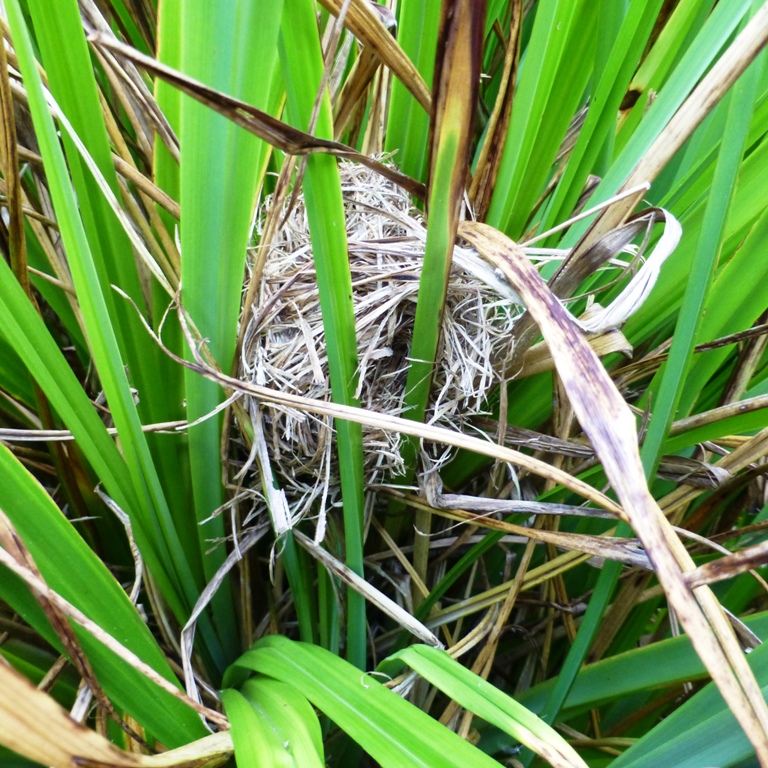
This is why Devon Mammal Group has set up a new county wide survey project to discover more. A training day at Stover Country Park in November, with excellent tutoring from The Mammal Society's Derek Crawley, showed us where and how to look; in a couple of hours our novice group found some 18 nests across two areas of the Country Park. The first was found within 5 minutes, a text book example grass-woven pom-pom attached half way up a reed stem amongst dense cover. This attachment to surrounding vegetation above ground level is a diagnostic feature.
Mouse house, exterior

Armed with such new knowledge, trained surveyors will explore sites around their local patches, for harvest mouse field signs of old summer nests. Harvest mice, we learned, need thickly-packed sward. They are tiny, about pygmy shrew size, about 5cm, with another 5cm of tail, and weigh around 7-8g (or as much as a 50p coin), which helps, as they like to climb. For this they have a tiny reach, hence grass and other upright stems need to be close together, and interlinked. Also harvest mice do not collect or transport nesting material to a nest site location, but must use whatever is to hand, or rather paw. 

This means the best places to start looking are among banks of thickly growing coarse grasses like Cock's-foot, or reeds, which haven't been cut or grazed for over a year or more, forming an impenetrable grassy forest. In high summer, nests should be impossible to find in this matrix of stems; instead the ideal time to survey is autumn-early winter, after vegetation dies down and before the attrition of winter weather destroys the old nest structures.

So .... a mouse mission, off on the trusty bicycle to check out some of Exeter's Valley Parks and other wilder, grassier, green spaces.

Mincinglake mouse habitat
Ludwell, Duryard and Barley Valley were now grazed down to short grass, and unsuitable. DWT's reserve at the Old Sludge Beds, where harvest mouse nests have been recorded in the past during reed-cutting management works, was not accessible off the boardwalk path. At Mincinglake, with unmown, extensive stands of Cock's-foot and other tall grasses, it was a different matter. 

Crouched peering face first while teasing through the dense sward might have looked slightly odd to any dog-walking onlookers. Two hours of this did not meet with any particular success, though there were plenty of vole signs in the form of runs and piles of nibblings under the matted canopy layer of collapsed old stems, and the habitat still appeared promising.

Teamwork is probably the answer: a few days later a group 30 strong from University of Exeter spent a similar amount of time here, discovering one genuine wild Exeter harvest mouse nest. It's official and wildlife-newsworthy - so little is known, but harvest mice are at Mincinglake, a valuable record for the city and the county. It fills in a blob on Devon Mammal Group's map,
though it took 60 person hours to find field signs of them.

If old nests are hard to find, practical chances of seeing live animals in the wild must be zero. Here are some pictures from the mousearium instead. It's fascinating viewing, watching them investigate new objects, pathways and food items. They are welcome to stay as long as they need.

Better than TV: watching the mousearium residents


UPDATE end of December 2016
Success! Wild harvest mouse nest found at Mincinglake over the Christmas break. Merry Xmouse!
Living on the sedge: Harvest mouse nest in clump of Pendulous sedge

 
For more harvest mouse info, visit this great harvest mouse webpage.

For anyone interested in surveying for harvest mice around Devon, further Devon Mammal Group workshops are to be held through 2017.

Tuesday, 15 November 2016

Murmuration by moonlight


Monday 14 November 2016

Wheeling flocks of hundreds of starlings over the Exe reed beds as the supermoon rose gleaming over the horizon ... is what we should have seen. Instead we were victims of meteorology. Over 30 of us stood in the dank gloom between the sewage works and the roar of the motorway, under a duvet of smothering cloud, looking at nothing.

We knew wildlife frequently fails to read the text books, or event programmes, but, we thought, at least there would be the incidental astronomy of the biggest supermoon of the century, the largest for 70 years, to view. No chance; not even the bright pinpoint of Venus could pierce the ambient fug.

So, no murmuration, and no moon either. Starlings have declined significantly, by some 80% over recent years*, but that wasn’t necessarily the reason for their absence from the Exe reed beds this evening. Flocks regularly re-locate their roosts from place to place, perhaps pursuing good feeding grounds or communal warmth, or to reduce individual risk from predators, three of the explanations postulated for flocks to converge, and the resulting murmuration displays**.  

Before the start time, a small group of 20-30 starlings was seen heading over Riverside Valley Park towards the city centre. Murmurations needn’t be a coastal or rural phenomena, and a University of Gloucestershire and Royal Society of Biology survey study over 2014-15*** received murmuration records from urban Manchester, Belfast, Edinburgh, Glasgow, Belfast and Port Talbot, not just Brighton pier. They have certainly been seen over the Exe reed beds from the Old Sludge Beds nature reserve and from Topsham. Just not on 14 November 2016.

Although missing during the organised event, the starling murmuration season continues all through winter, with flocks progressively increasing in size as birds arrive from the Continent, so there should be other chances for an independent trip to the site to view the spectacle near Exeter. Autumn dusk can be an interesting atmospheric time in any case: snipe and redwing were calling, and we saw and heard common and green sandpiper, plus a bolt of blue kingfisher; ranks of cormorants warmed their feet on the high tension power lines; gulls and corvids rotated above, perhaps tracking an insect swarm, or a thermal generated by the motorway, or both. A late pipistrelle bat flitted briefly overhead.

And, despite being denied the opportunity to witness the supermoon in full refulgent glory, there will be a nearly complete moon for the next couple of evenings, for a ‘slightly not quite so super’ moon. Supermoons are not so uncommon: each full moon at perigee on its elliptical orbit around, and when closest to, the Earth, gives the supermoon effect. The 14 November event was special because the moon was exceptionally close: at 221,524 km distance, compared to more typical 356,400 km****, and with the moon rising within hours of becoming full at 1.52pm, this was a kind of extra enhanced supermoon, not recurring for 18 years.     

Many thanks to all those who joined us and persevered through the event. Because the wildlife didn't share the same level of commitment, I couldn't bring myself to take a photo, but here's the poster, as a memento of what could have been, with Dawn Monrose's great picture of the elusive avifauna. Maybe we'll try again for the next extra-supermoon on 25 November 2034. 


References and sources
*      RSPB website
**    Andrew J King & David JT Sumpter 2012 Quick Guides Murmurations Current Biology 22 (4): pR112–R114 open access
***   University of Gloucestershire and Royal Society of Biology study, led by Dr Anne Goodenough 
**** Peter Grego 2010 Philip’s Moon Observer’s Guide revised ed. Octopus Publishing / Philip’s, London; SNAPPA science website